

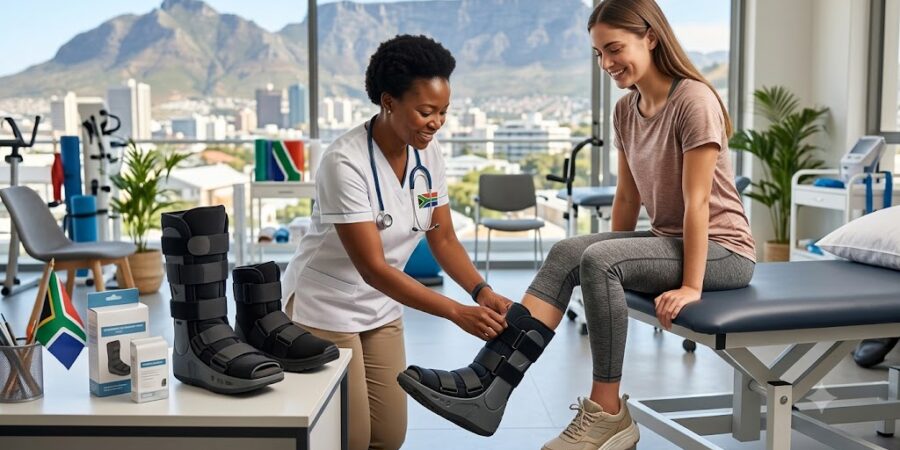
The wrong type, size, or fit can slow down healing, cause unnecessary discomfort, and even create secondary issues like poor walking mechanics, hip strain, or lower back pain.
A medical moon boot also called a walking boot, CAM (Controlled Ankle Motion) boot, or air walker is one of the most common orthopedic devices used to treat foot and ankle injuries. While they may look simple, choosing the correct boot plays an important role in protecting your injury and supporting recovery.
What Is a Medical Moon Boot?
A CAM boot is a specialized orthopedic brace designed to immobilize the foot, ankle, or lower leg while still allowing controlled weight-bearing where safe.
Unlike a traditional, rigid plaster cast, a walking boot offers flexibility: it can usually be removed under the guidance of your healthcare professional for hygiene, wound care, or early rehabilitation exercises.
The engineering behind a moon boot relies on a few key components:
- The Rigid Shell: Prevents side-to-side twisting (inversion and eversion) and forward bending.
- The Rocker-Bottom Sole: A curved sole that mimics the natural rolling motion of your foot, reducing the force transferred to your injury when you step.
- The Cushioned Liner & Straps: Secures the limb evenly to prevent friction and blister-causing slippage.
Common Injuries & Boot Selection
Different injuries require entirely different levels of immobilization. The table below outlines how specific diagnoses dictate the type of boot required.
| Injury Type | Typical Boot Height | Why This Specific Design Matters |
| Toe & Forefoot Fractures | Short Boot | Focuses immobilization on the front of the foot; allows normal upper calf movement. |
| Metatarsal Fractures | Short or Long | Depends on the specific bone broken (e.g., a 5th metatarsal Jones fracture often requires a long boot for extra stability). |
| Severe Ankle Sprains | Long Boot | Leverages the upper calf to completely halt the side-to-side twisting of the ankle joint. |
| Stable Ankle Fractures | Long Boot | Keeps the tibia and fibula perfectly aligned during bone consolidation. |
| Achilles Tendon Injuries | Long Boot + Wedges | Requires a long boot fitted with internal heel wedges to keep the foot pointed downward (plantarflexion), taking the tension off the healing tendon. |
⚠️ Critical Rule: Always Get a Diagnosis First
Never self-prescribe a moon boot based purely on where it hurts. Some complex fractures require a non-weight-bearing plaster cast, while certain ligament tears should not be walked on at all. Always see a doctor, physiotherapist, podiatrist, or orthopedic surgeon before buying.
Short vs. Long Moon Boots
The height of the boot determines exactly where your leg’s range of motion is restricted.
1. Short Walking Boots
Covers the foot and terminates just above the ankle.
- Best for: Isolated toe injuries, forefoot trauma, or stable conditions where the ankle joint itself doesn’t require rigid leverage to stay still.
- Benefit: Lighter, cooler, and allows slightly more natural mobility through the upper calf.
2. Long Walking Boots
Extends all the way up the calf to just below the knee.
- Best for: Ankle sprains, lower leg fractures, Achilles issues, and post-surgical recovery.
- Benefit: Provides maximum stability. By gripping the upper calf, it dramatically reduces the weight and rotational forces traveling down into your ankle and heel.
Pneumatic (Air) vs. Standard Walking Boots
When choosing a boot, you’ll have to decide between a standard model or a pneumatic (air-pump) upgrade.
Standard Moon Boots
Standard boots rely entirely on thick, high-density foam inserts for padding and support. They are highly effective, cost-efficient, and perfectly suited for straightforward injuries where swelling isn’t a massive variable.
Pneumatic (Air) Moon Boots
Pneumatic models feature built-in air bladders built into the liner, alongside a small, integrated hand pump.
- Customized Fit: As swelling goes down during your recovery, you can pump up the air chambers to keep the boot perfectly snug.
- Compression Benefits: The targeted air pressure provides gentle compression, which actively helps reduce localized swelling and inflammation.
How to Get the Correct Fit and Size
Most manufacturers size moon boots according to standard shoe sizes (Small, Medium, Large, XL). However, getting the physical fit right is what prevents complications.
When trying on your boot, use this checklist:
- [ ] The Heel Lock: Your heel must sit firmly against the very back wall of the boot shell. If your heel lifts or slides forward when you step, the boot is too large.
- [ ] The Toe Line: Your toes should sit comfortably inside the protective plastic perimeter of the boot. If they overhang the front edge, they are at risk of stubbing or re-injury.
- [ ] The Snugness Test: Straps should be firmly fastened from the bottom up. They should feel snug like a firm hug not so tight that they cause pins and needles, numbness, or turn your toes white or blue.
Tips for Walking Safely and Comfortably
Because a moon boot has a thick rocker sole, your injured leg will suddenly be slightly taller than your uninjured leg. This creates a leg-length imbalance that can cause lower back, hip, and knee pain within just a few days of limping.
- Equalize Your Height: Wear a supportive trainer or shoe with a thicker sole on your good foot to level out your hips. If the boot is still significantly taller, consider buying a temporary shoe leveler (an adjustable strap-on platform for your normal shoe).
- Use the Rocker Sole: Don’t try to lift and stomp. Allow your foot to roll smoothly from heel to toe along the curved bottom of the boot.
- Wear Long Socks: Always wear a tall, breathable cotton sock underneath the boot liner. This absorbs sweat, prevents skin chafing, and keeps the liner cleaner for longer.
Navigating Medical Aid in South Africa
A moon boot is classified as Durable Medical Equipment (DME) or an orthopedic orthosis. Most South African medical schemes (such as Discovery, Bonitas, Medihelp, and Momentum) will cover the cost, but rarely if you buy it off the shelf as a cash purchase without a paper trail.
To maximize your chances of getting reimbursed from your medical savings account or core benefits, ensure you tick these three boxes:
📋 Medical Aid Checklist
- The Prescription: You must have a physical script from a registered healthcare professional (GP, specialist, podiatrist, or physiotherapist).
- The ICD-10 Diagnosis Code: Your doctor’s script and the medical supplier’s invoice must clearly state the correct ICD-10 code (e.g.,
S92.3for a metatarsal fracture). If these codes don’t match, the claim will be rejected.- The Provider’s BHF Practice Number: Ensure you purchase from a pharmacy or medical equipment supplier that has a valid Board of Healthcare Funders (BHF) practice number printed on their invoice.
Frequently Asked Questions
Can I sleep in my moon boot?
This depends entirely on your injury. For unstable fractures or post-operative healing, your surgeon may mandate wearing it 24/7. For softer tissue injuries, you may be allowed to take it off. If you must sleep in it, loosening the straps slightly (but keeping the structural shell intact) can help with comfort.
How long will I need to wear it?
Most bone fractures and severe ligament tears require anywhere from 4 to 8 weeks in a boot, followed by a gradual transition back into standard footwear combined with targeted physical therapy.
Can I drive while wearing a moon boot?
If the boot is on your right foot, it is generally illegal and highly unsafe to drive an automatic or manual vehicle, as it severely compromises your reaction time and pedal feel. If it is on your left foot and you drive an automatic, it may be permissible, but you must check with your vehicle insurance provider first to avoid voiding your coverage.
Find Vetted Orthopedic Suppliers Across South Africa
Choosing the right recovery equipment shouldn’t be a guessing game. If you have your prescription ready and need to source a high-quality standard or pneumatic walking boot:
Browse our Orthopedic Devices & Equipment Listings to compare local suppliers, view medical-grade brands, and find the right device to support your road to recovery.
