

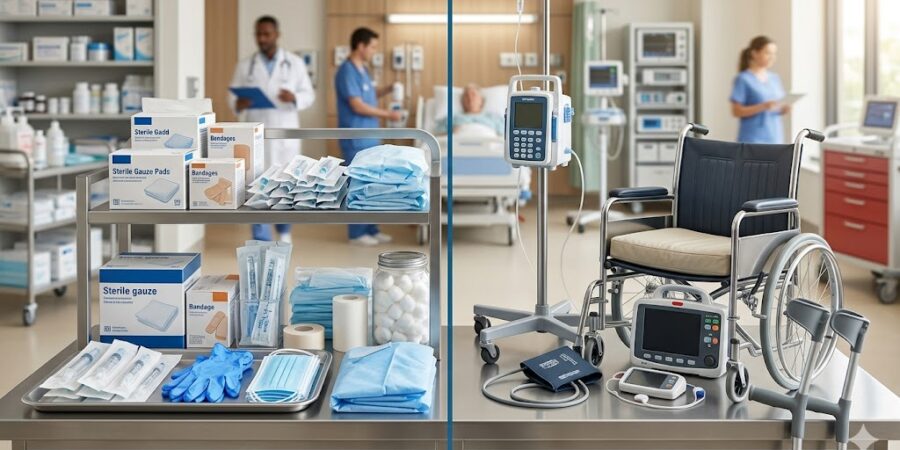
In the healthcare industry, the terms medical supplies and medical equipment are frequently used in the same breath. While they both share the ultimate goal of improving patient outcomes, they represent two entirely different categories of assets.
Distinguishing between the two is vital for healthcare providers managing budgets, caregivers stocking a home, and patients navigating insurance claims. This guide breaks down the core differences in lifespan, cost, and usage.
What are Medical Supplies? (The Consumables)
Medical supplies are the “bread and butter” of daily clinical operations. These are consumable, disposable items designed for short-term use. Once a medical supply is used, it is typically discarded to maintain hygiene and prevent cross-contamination.
Because they are used in high volumes, these items require constant inventory management and frequent restocking.
Key Characteristics of Medical Supplies:
- Disposable: Often single-use and sterile-packaged.
- Low Per-Unit Cost: Generally inexpensive compared to machinery.
- Operational Expense: They represent recurring costs for a facility.
- No Maintenance: They do not require servicing; they are simply replaced.
Common Examples:
- Wound Care: Bandages, gauze, adhesive tapes, and sutures.
- Personal Protective Equipment (PPE): Gloves, surgical masks, and disposable gowns.
- Injectables: Syringes, needles, and IV fluids.
- Diagnostic Supplies: Cotton swabs, tongue depressors, and disposable thermometers.
What is Medical Equipment? (The Durables)
Medical equipment refers to durable, long-lasting devices intended for repeated use over months or years. Unlike supplies, equipment is built to withstand wear and tear and is often used to diagnose, monitor, or treat specific medical conditions over time.
This category is often referred to as Durable Medical Equipment (DME), especially in home care and insurance contexts.
Key Characteristics of Medical Equipment:
- Durable: Designed for long-term use and multiple patients.
- High Investment: Often involves a significant upfront capital expenditure.
- Maintenance-Heavy: Requires regular calibration, servicing, and technical repairs.
- Training Required: Often requires specialized knowledge or professional certification to operate safely.
Common Examples:
- Diagnostic Equipment: MRI machines, X-ray systems, and ECG monitors.
- Mobility & Support: Wheelchairs, hospital beds, and patient lifts.
- Life Support: Ventilators, oxygen concentrators, and defibrillators.
- Home Care: CPAP machines for sleep apnea and blood pressure monitors.
Key Differences at a Glance
| Feature | Medical Supplies | Medical Equipment |
| Lifespan | Single-use or short-term | Long-term and durable |
| Durability | Disposable | Reusable |
| Cost Type | Recurring operational cost | Capital expenditure |
| Maintenance | None required | Regular servicing/calibration |
| Storage | High-volume inventory (restocking) | Permanent floor or shelf space |
How They Work Together
In practice, supplies and equipment are two halves of a whole. One cannot function effectively without the other. For example:
- A patient monitor (Equipment) requires disposable electrodes (Supplies) to track a heart rate.
- A ventilator (Equipment) requires sterile tubing and filters (Supplies) that must be changed for every patient.
- A blood pressure monitor (Equipment) uses alcohol prep pads (Supplies) to clean the skin before use.
While these terms are distinct, they are also different from “medical devices”, a broader regulatory category that encompasses both. To learn more about how these categories overlap, read our deep dive on the difference between medical equipment and medical devices.
Why the Distinction Matters
1. Financial Planning
For a hospital or clinic, medical supplies are managed as “inventory,” while equipment is treated as an “asset” that depreciates over time. Understanding this helps in accurate budgeting and tax reporting.
2. Patient Safety
Using a medical supply (like a syringe) more than once is a safety violation. Conversely, failing to maintain medical equipment (like an infusion pump) can lead to device failure. Recognizing which category an item falls into ensures it is handled according to safety standards.
3. Insurance and Reimbursement
Insurance providers often have different coverage rules for “supplies” versus “DME.” Knowing the difference can prevent unexpected out-of-pocket costs for patients and home caregivers.
Conclusion
Whether you are managing a large-scale hospital or caring for a loved one at home, knowing the difference between supplies and equipment is the first step toward efficient care. Supplies keep the facility running day-to-day, while equipment provides the technological foundation for long-term healing.
