

Key Takeaways
- Prioritise Stability with Walkers: Opt for a walker if you are recovering from surgery (such as a hip or knee replacement) or need to lean heavily on the device for weight-bearing support.
- Boost Endurance with Rollators: Choose a rollator if you can walk independently but require a built-in seat for rest breaks during longer outings or shopping trips.
- Assess the Environment: Walkers are generally better for narrow indoor hallways and small rooms, while rollators excel on outdoor paths and uneven pavements.
- Safety Requires Coordination: A rollator user must have the hand strength and reflexes to operate manual brakes; if coordination is a concern, a stationary walker is the safer choice.
- Weight Matters: Walkers are typically lighter and easier to lift into a car, whereas rollators are bulkier due to the addition of wheels, seats, and braking systems.
Mobility aids help people stay independent, confident, and safe when walking becomes more challenging due to age, injury, surgery, or long-term health conditions. For elderly users in particular, choosing the right walking aid can make a significant difference to daily quality of life. Two of the most commonly used options are walkers and rollators. While they are often grouped together, they are designed for different levels of support and suit different mobility needs.
Choosing between a walker and a rollator is not about which is “better,” but about which one matches the user’s balance, strength, environment, and lifestyle.
Are walkers and rollators the same?
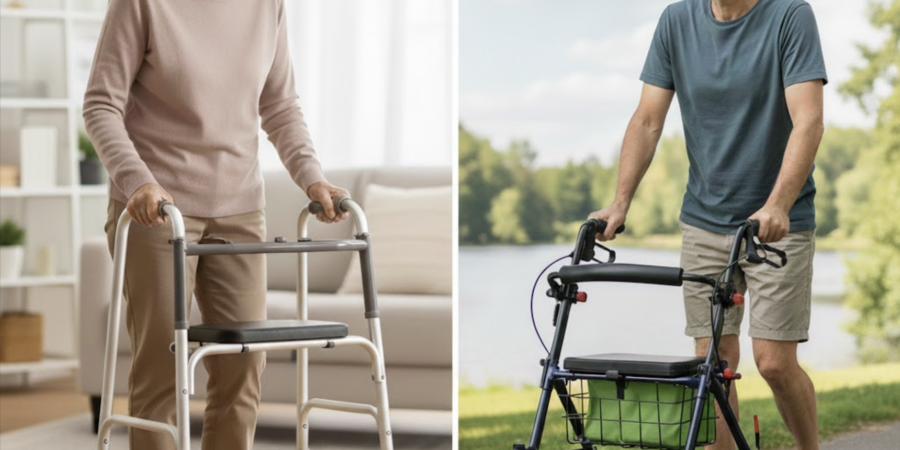
Walkers and rollators are not the same, although both are designed to support walking. A walker is built to provide a high level of stability and weight-bearing support. It remains firmly in place unless lifted or slid forward. A rollator, by contrast, has three or four wheels and moves continuously as the user walks, offering balance support rather than full weight support.
Because of this difference, walkers are typically recommended for people with greater mobility limitations, while rollators are better suited to those who can walk independently but need added stability or endurance support.
What is a walker?
A walker is a rigid frame, usually made from lightweight aluminium, with four legs that make contact with the ground. Some models include two front wheels to make forward movement easier, while others have no wheels at all. Walkers are designed to provide maximum stability and are commonly used during rehabilitation or when balance and strength are significantly reduced. Walkers are especially effective indoors and in controlled environments where short, deliberate steps are needed.
Walkers for elderly users are among the most frequently recommended mobility aids, particularly following surgery or during periods of reduced strength and confidence.
Common features of walkers include:
- A lightweight but strong frame
- Height-adjustable handles
- Four legs, with or without front wheels
- Rubber tips or glide caps for grip
- Foldable design for storage
Pros and cons of a walker
Pros: Provides high levels of stability; suitable for partial weight-bearing through the arms; less likely to move unexpectedly; easy to manoeuvre in tight indoor spaces.
Cons: Requires lifting or sliding with each step; slower walking pace; lacks a built-in seat for resting; can be difficult to use on uneven outdoor surfaces.
Walkers are generally best suited for:
- People who need to bear weight through their arms while walking
- Individuals with significant balance or stability issues
- Post-surgical recovery, such as after hip or knee replacement
- Older adults who need a dependable, easy-to-use aid for indoor daily life
- Indoor use in smaller spaces or narrow hallways
What is a rollator?
A rollator is a wheeled walking aid designed to support balance, confidence, and endurance rather than full body weight. Most rollators have four wheels, although three-wheel models are also common for tighter spaces. Unlike walkers, rollators are pushed forward as the user walks and do not need to be lifted. Most rollators include hand-operated brakes, a built-in seat, and a storage basket or pouch, making them excellent for active use.
Common features of rollators include:
- Three or four wheels for smooth movement
- Hand-operated brakes for speed control and safety
- A built-in seat on most four-wheel models
- Storage baskets or pouches
- Adjustable handle height
Pros and cons of a rollator
Pros: Encourages a natural walking pattern; built-in seat allows for rest breaks; better suited for outdoor use; storage options increase independence.
Cons: Less stable than a standard walker; not suitable for full weight-bearing; requires coordination to use brakes safely; bulkier to transport.
Rollators are generally best suited for:
- People who can walk independently but need balance support
- Individuals who tire easily and benefit from frequent rest breaks
- Active users who spend time outdoors or walking longer distances
- Users who can safely operate hand brakes
Key differences between walkers and rollators
| Feature | Walker | Rollator |
| Wheels | 0 to 2 | 3 to 4 |
| Weight Support | Can support significant body weight | Supports balance, not full weight |
| Movement | Lift or slide | Rolls continuously |
| Brakes | No | Yes, hand-operated |
| Built-in Seat | No | Yes (most 4-wheel models) |
| Portability | Very lightweight and compact | Larger but often foldable |
| Best Use | Stability, recovery, and indoor use | Balance, endurance, and outdoor mobility |
Which walker is best for the elderly?
The best walker for an elderly person depends on their specific level of mobility, strength, and where they plan to use it most. A standard four-leg walker with no wheels offers the greatest stability and is well suited to those recovering from surgery or with significant balance difficulties. For elderly users who are more mobile but still need support, a two-wheel walker or a lightweight rollator may allow for a more natural walking pace. Height adjustability, grip comfort, and ease of folding for transport are all worth prioritising when selecting a walker for older adults.
What type of walker is best for balance problems?
For people with balance problems, a standard walker without wheels is generally the safest starting point, as the frame stays firmly in place and does not roll unexpectedly. The user can lean into it with confidence while stepping forward. Those with mild to moderate balance difficulties who retain reasonable hand coordination may also find a four-wheel rollator with reliable brakes to be effective, as it encourages an upright posture and a more fluid gait. In either case, an assessment from a physiotherapist or occupational therapist can help match the device to the individual’s specific needs.
Which is safer: a walker or a rollator?
Safety depends on the user rather than the device itself. Walkers are generally considered safer for people with poor balance or those who need to place significant weight through the walking aid, as the frame remains stable and does not roll unexpectedly. Rollators are safe and effective for users who have reasonable balance and coordination. For these individuals, the smoother movement and built-in seat can actually reduce fatigue-related falls.
What is the disadvantage of a rollator?
The main disadvantage of a rollator is reduced stability compared to a standard walker. Because it rolls freely, it can move too quickly if the brakes are not used correctly, particularly on slopes. Rollators also require more space to manoeuvre and are generally not suitable for people who must rely on their mobility aid for total weight-bearing support.
Who would a rollator not be appropriate for?
A rollator may not be appropriate for individuals who have severe balance problems, a high risk of frequent falls, or those who lack the hand strength or coordination to operate the brakes. It is also not recommended for those who need to lean heavily on the device for support, as the wheels could slide forward and cause a fall.
How do I use a walker or rollator?
Using a walker involves placing the frame slightly ahead, ensuring all legs are stable on the ground, and then stepping forward into the frame. This method prioritises control. Using a rollator involves pushing the device forward as you walk, staying between the handles, and applying the brakes whenever stopping. The brakes should always be locked before using the built-in seat to prevent the device from rolling away.
Final thoughts
Walkers and rollators are both effective mobility aids, but they serve different roles. Walkers prioritise stability and recovery, while rollators focus on balance and mobility for an active lifestyle. For elderly users especially, choosing the right option comes down to an honest assessment of strength, coordination, and daily environment. When in doubt, a consultation with a healthcare professional can ensure the safest and most suitable choice.
Download: Choosing Your Mobility Aid: A Discussion Guide for Your Doctor
